Choosing between cleaning companies in Australia starts with matching the service to your premises, risks and operating hours—not simply comparing headline prices. This article explains how to assess office, medical, industrial and carpet cleaning proposals, prepare a useful brief and check what a provider will deliver. Use it to turn a broad search into a practical shortlist and a clearly defined cleaning arrangement.
Key takeaways
- Match the service to your premises, risks and operating hours, not just headline prices.
- Give every shortlisted provider the same brief, and ask them to record assumptions and exclusions in writing.
- Compare quotes against the same task list, frequency and conditions, including itemised costs, GST and payment terms.
- Check safety arrangements for chemicals, training and protective equipment before work begins.
- Review the written scope before accepting, because an accepted quote becomes a legally binding contract.
What should you look for in an Australian cleaning company?
Look for a cleaning company that can explain its proposed tasks, demonstrate relevant capability and put its commitments in writing. Ask how it will manage access, supervise work, cover absences and resolve missed tasks. A written quote should identify the business, describe the service, itemise costs and state payment terms and applicable GST. Australian Government guidance recommends these details as foundations of a clear quote.
Before requesting proposals, prepare a short brief covering:
- Your premises: List rooms, floor surfaces, amenities, storage areas and restricted spaces.
- Your priorities: Identify presentation concerns, recurring problems and areas needing particular attention.
- Your schedule: State available cleaning windows, occupancy patterns and shutdown periods.
- Your boundaries: Explain who may move equipment, handle documents or enter sensitive areas.
- Your expectations: Describe how completed work will be checked and who receives reports.
Give every shortlisted provider the same brief. Ask them to identify assumptions rather than silently filling gaps, and request a site inspection before accepting a final proposal. Use the written scope to record agreed changes, keeping the service description and price aligned.
Match the cleaning service to the site
Avoid relying on a broad service label alone. Instead, ask each provider to describe the tasks, equipment and safety arrangements proposed for your premises. WorkSafe Victoria identifies chemical handling, equipment and waste handling among cleaning hazards, making the planned method an important part of the discussion.
Office and commercial cleaning
When comparing office cleaning in Australia, start with a room-by-room task list rather than an instruction to “clean everything”. Ask providers to separate routine work from periodic tasks and explain any exclusions. For broader commercial cleaning in Australia, use the same approach across customer-facing areas, staff facilities and back-of-house spaces so the quotation describes the actual work required.
For example, specify whether the proposal should cover accessible desks, internal glass, kitchen appliances or meeting-room resets. Ask how staff should prepare workstations and whether cleaners may move personal items. Record these boundaries in the scope rather than leaving individual cleaners to interpret them during each visit.
Medical cleaning
When assessing medical cleaning services in Australia, ask how the proposed program fits your facility’s infection prevention procedures. Australian healthcare guidance treats environmental cleaning as part of infection prevention and control, with risk assessment, product selection, staff responsibilities and auditing all relevant to the program. Appearance alone is therefore not a sufficient basis for evaluating the service.
Request clear responsibilities for environmental surfaces, shared patient-care equipment and spill response. Ask who approves products, how staff receive site-specific instruction and how completed work is documented. National guidance distinguishes general surfaces from shared clinical equipment, which can require cleaning between patient uses; your agreement should make those responsibilities explicit.
Industrial cleaning
For industrial cleaning services in Australia, ask providers to assess the work environment before proposing equipment or methods. Discuss chemical exposure, waste handling, movement of cleaning equipment and any restrictions around production areas. Request an explanation of the controls and training relevant to the proposed tasks, rather than accepting a general assurance that staff “work safely”.
Also ask how floor cleaning will account for the surface and the contamination present. WorkSafe Queensland advises tailoring cleaning systems to flooring and contaminants, and warns that unsuitable methods or chemical solutions can make surfaces slippery. Use that discussion to agree when areas can be cleaned and how access will be managed during the work.
Carpet cleaning
When requesting carpet cleaning services in Australia, ask for a separate written scope identifying the rooms, approximate areas and specific concerns to be assessed. Request clarification about furniture movement, access arrangements and any work excluded from the price. Have the provider record qualifications or limitations in the proposal rather than relying on an informal promise about the final result.
How can you compare cleaning quotes fairly?
Compare cleaning quotes against the same task list, frequency and conditions, then investigate differences before choosing. Request itemised costs, a clear description of the service, applicable GST, payment terms and separately identified extras. Both Australian Government and Business Queensland guidance emphasise clear scope and pricing information in written quotations. For typical Greater Sydney commercial cleaning price ranges and what drives them, see our 2026 commercial cleaning cost guide.
Use this checklist during your review:
- Match the areas. Check that each proposal covers the same rooms, surfaces and facilities.
- Match the frequency. Distinguish work included at every visit from separately scheduled tasks.
- Identify extras. Ask whether supplies, specialist tasks or additional visits carry separate charges.
- Record exclusions. Resolve unclear wording before accepting the quote.
- Check timing and terms. Confirm commencement, payment arrangements and the quote’s expiry date.
- Document revisions. Ask for an updated written proposal when the agreed scope changes.
To make the side-by-side comparison easier, use our free quote comparison sheet. Record each provider’s price, task frequencies, inclusions and exclusions in one place.
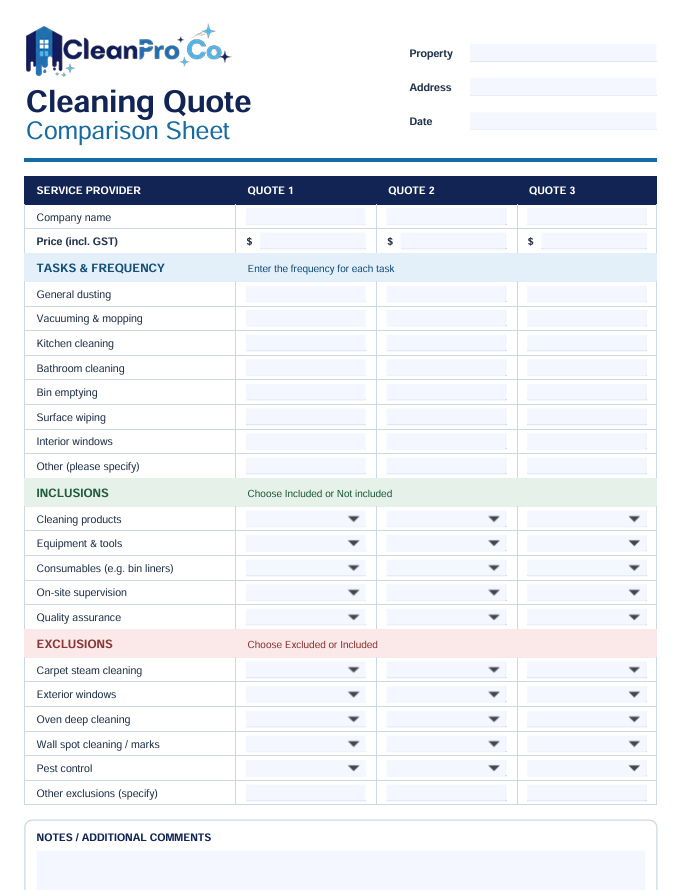
For example, ask both bidders whether internal glass cleaning and consumable replenishment are included, excluded or optional. Do not assume two similarly titled packages contain identical tasks. Keep the comparison focused on the written offer, and ask each provider to explain how its proposed service addresses your brief.
Check safety arrangements before work begins
Ask to see how the provider manages cleaning chemicals, including product labels, safety data sheets and worker instruction. Safe Work Australia notes that cleaning products can present health and physical hazards, and that some chemicals become more harmful when mixed. Discuss storage and handling with the provider rather than treating the cleaning cupboard as an afterthought.
Request a practical explanation of how cleaners will protect themselves and others during the agreed tasks. Relevant questions include how workers access chemical safety information, what protective equipment is selected and how spills or exposure are reported. WorkSafe Victoria’s cleaning guidance addresses worker training, chemical exposure controls and appropriate protective equipment.
Where you want lower-impact products, ask which products are proposed and whether a less hazardous option can perform the task. Avoid treating a broad environmental description as a substitute for reviewing product information. WorkSafe Victoria recommends eliminating hazardous substances where possible or considering less harmful products, processes or forms of the substance.
Make your Sydney brief specific to the premises
If you are comparing cleaning services in Sydney, Australia, give providers the building details needed to prepare a specific proposal. Ask them to account for entry arrangements, parking or loading access, lift bookings, permitted working hours and equipment storage where relevant. Record any resulting conditions or additional charges in the written quote.
For a multi-site brief, list each address and its required tasks separately rather than asking for one undefined service package. Request a site-level breakdown of frequency, exclusions and costs, then clarify any differences. This keeps the quotation tied to a clear description of the work instead of relying on a broad claim of coverage.
Turn the proposal into a workable arrangement
Before accepting, review the proposal with the person who will oversee cleaning at your premises. Check the scope against the original brief, resolve outstanding exclusions and make sure revisions appear in writing. Australian Government guidance notes that an accepted quote becomes a legally binding contract, so settle uncertainties before acceptance rather than after work starts.
Use that review to confirm who communicates changes, how additional work is approved and where service concerns should be directed. For healthcare premises, also confirm the arrangements for monitoring and auditing environmental cleaning. Keep the final documents accessible to the people responsible for managing the service.
The practical takeaway is straightforward: choose against a clear brief, not a vague promise. Ask for site-appropriate methods, transparent inclusions and written terms you understand. A well-defined proposal gives you a firmer basis for deciding which provider fits your premises and for discussing performance once cleaning begins.
Cleanpro is a family-owned commercial cleaner serving Greater Sydney since 2015. If you would like a free site walkthrough and a written, itemised scope — with police-checked staff and no lock-in contracts — get in touch.